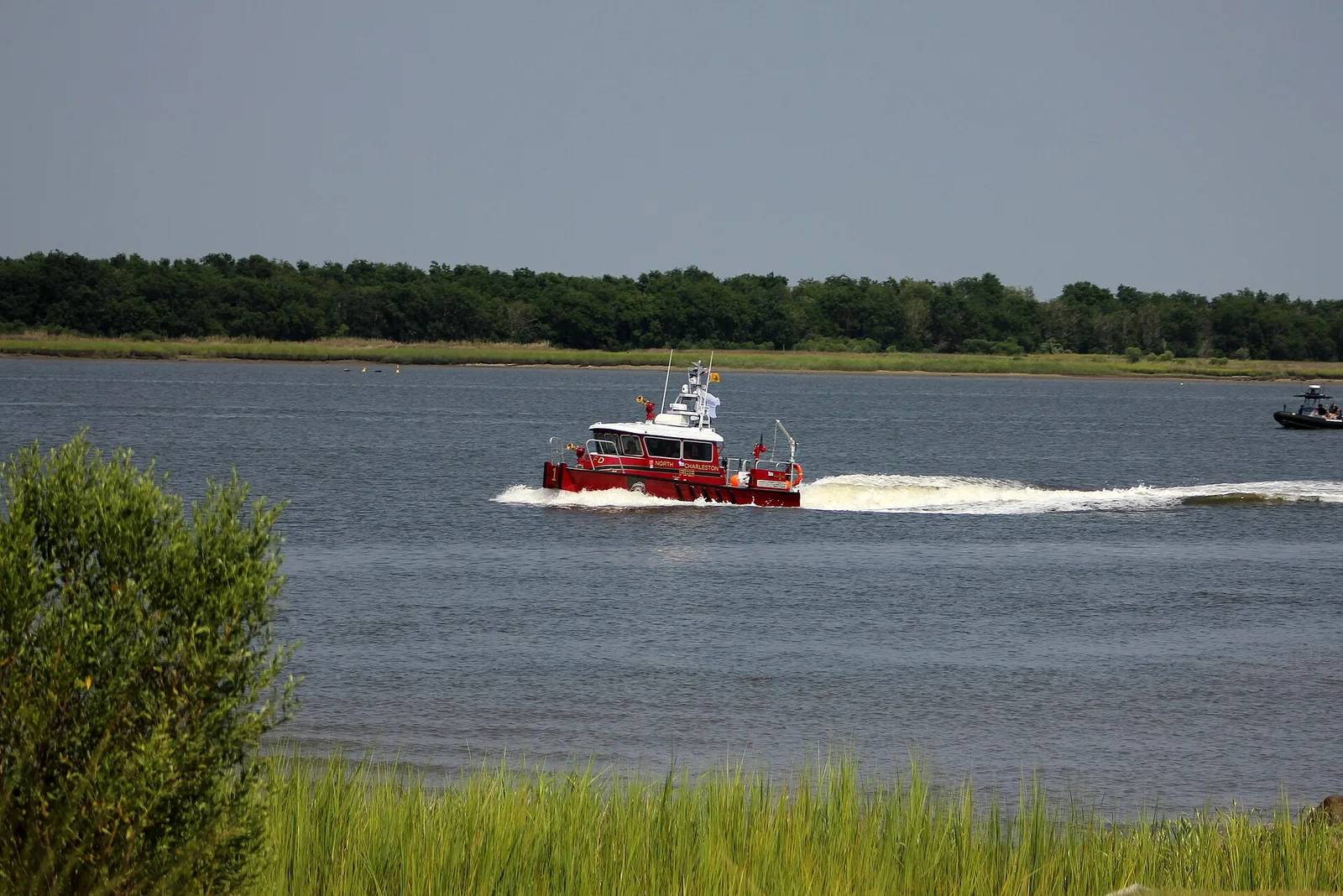
Two Homeland Security grants worth $380,872 will pay for rescue training, dive team gear and new boat engines. The city adds $95,139 to cover its share.
Overview
The U.S. Department of Homeland Security has awarded North Charleston two grants worth $380,872.63 in federal money. One pays for advanced rescue training for firefighters. The other buys dive team gear, new boat engines and radar training for crews who work the Port of Charleston. The city puts in $95,139.37 of its own as its required share.
The federal award letters are in the City Council’s items for its Oct. 22 meeting. Resolutions to accept both grants were on the Oct. 22 agenda. The city has not yet posted the minutes of that meeting.
The two grants at a glance
| Grant | Federal share | City share | Total | What it pays for |
|---|---|---|---|---|
| FY 2025 Assistance to Firefighters Grant | $136,363.63 | $13,636.37 | $150,000 | Technical rescue training |
| FY 2026 Port Security Grant | $244,509 | $81,503 | $326,012 | Dive team gear, boat engines, radar training |
| Both | $380,872.63 | $95,139.37 | $476,012 |
Both figures come from the FEMA award letters and the city staff summaries in the council items. The city’s share comes from its contingency account, the staff summaries said. Both grants also need a budget increase, which staff said will come to council as part of the budget reconciliation for the year ending in 2027.
Rescue training for firefighters
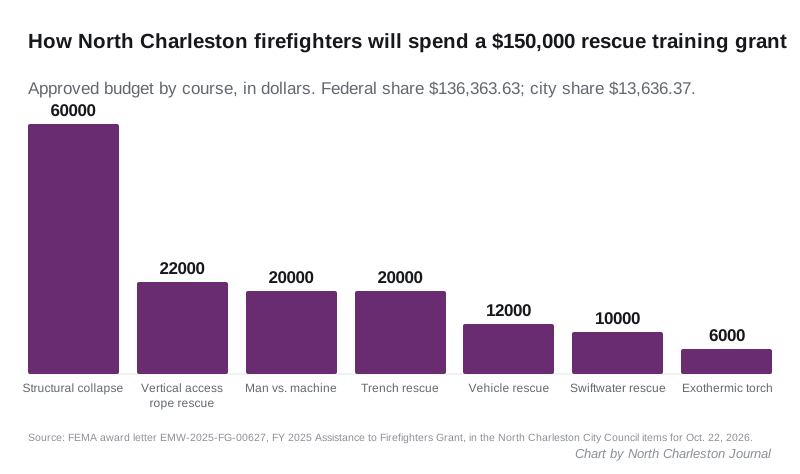
The $150,000 Assistance to Firefighters Grant pays only for training. FEMA’s approved scope lists seven courses:
- Structural collapse, $60,000: 20 firefighters, for buildings that fall after storms, explosions, vehicle impacts or construction failures
- Vertical access rope rescue, $22,000: 16 firefighters, for high-angle and low-angle rescues
- Man vs. machine, $20,000: 60 firefighters, for freeing people trapped in industrial, farm and factory equipment
- Trench rescue, $20,000: 16 firefighters, for trench and excavation collapses
- Vehicle rescue, $12,000: 20 firefighters, including electric and hybrid vehicle hazards
- Swiftwater rescue, $10,000: 10 firefighters, for hurricanes and floods
- Exothermic torch operations, $6,000: 15 firefighters, for cutting through steel and reinforced concrete
The application said the structural collapse course is normally open only to members of South Carolina’s urban search and rescue task forces. North Charleston is not part of one, it said.
Dive team gear and boat engines for the port
The Port Security Grant totals $326,012. The staff summary splits it this way:
- $266,056 for equipment
- $51,796 for training
- $8,160 for travel to training
The resolution says the grant benefits both the Fire Department and the Police Department. Items FEMA approved include:
- two replacement outboard engines, at $30,339 and $30,992, for boats that respond in the Port of Charleston
- joystick, autopilot and digital steering upgrades for the twin-engine controls
- 10 replacement drysuits for the city’s dive team, $43,100
- 10 scuba tanks, $2,725.20
- an enclosed trailer to carry dive team equipment, $6,420.05
- a U.S. Coast Guard radar observer course for 10 people, $8,175
FEMA turned down two requests. It marked $85,000 for maintaining sensors, navigation and firefighting equipment on the city’s port security boats as ineligible. It did the same for a $50,000 portable radio amplifier. Neither was funded.
What it means for you
Nothing changes for residents right away. Federal money covers about 80% of the combined cost, and the city’s share comes from money it already set aside for contingencies, the staff summaries said. The training covers the rescues that call for specialists: a trench cave-in on a building site, a worker caught in machinery, a car crash with people trapped, or flooding after a hurricane.
The award letters do not give dates for when the courses will run or the equipment will arrive.
Have your say